
Don't Replace Feasibility Thinking
How to evaluate AI-assisted feasibility tools and
still get a defensible development decision.
A feasibility study is only as good as the questions driving it. Modern platforms can compress iteration time by days or weeks, but still require a professional to ask the right questions, validate inputs, and connect outputs into a defensible recommendation.
AI-assisted feasibility for new construction
AI-assisted feasibility is the use of software—often generative design, automated data extraction, and workflow automation—to speed up parts of a feasibility study: site and zoning screening, test-fit/massing, early quantities/cost proxying, market research, underwriting, and scenario testing. The keyword is “assist.”
Feasibility remains a decision process that must reconcile site constraints, entitlements, constructability, costs, schedule, market demand, and risk.
What these tools do well—and where they mislead
1 Tool categories are specialized
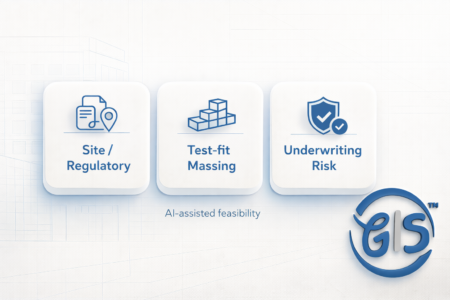
Most tools focus on: site/regulatory screening, test-fit/massing, or underwriting/scenario modeling.
2 Outputs amplify the operator
Tool outputs improve when the operator knows what to ask; AI amplifies prompt quality and the assumptions behind it.
3 Market research is required input
Comps, competing product mix, absorption, and cap-rate dynamics must be sourced and stated before the pro forma is decision-grade.
4 Test-fit isn’t market analytics
Generative test-fit (e.g., TestFit) can accelerate option generation, but it does not substitute for market analytics.
| Category | What it speeds up | What still needs professional judgment |
|---|---|---|
| Site / Regulatory | Early constraint screening, references, fast triage of issues. | Overlay interactions, parking exemptions, discretionary triggers, local practice and timing risk. |
| Test-fit / Massing | Rapid layout iteration (unit mix, setbacks, circulation, parking), early scenario exploration. | Competitive set, product positioning, absorption realism, and how exit pricing responds to cap-rate movement. |
| Underwriting / Scenarios | Faster model iteration, sensitivity runs, packaging outputs. | Cost credibility, timeline realism, market-backed rents/sales, absorption-backed velocity, downside framing. |
The missing ingredient in most “AI feasibility” conversations: question design
Owners often approach tools as if the tool contains the answer. In practice, the tool responds to the operator’s questions and inputs.
Buying a professional camera does not produce a professionally composed photograph. A professional-grade power tool does not build a house. Professional-grade AI feasibility tools do not produce useful feasibility work unless someone experienced is driving them.
Three operator questions that separate useful feasibility from noise
1) What decision is this supporting?
Acquisition go/no-go, entitlement strategy, JV pitch, lender package, redesign, or value engineering.
2) What constraint actually binds?
Zoning envelope, parking, height, construction type, entitlement timeline, basis, rents/sales, debt terms, or absorption.
3) What must be validated first?
Market comps, contractor budget reality, discretionary approval risk, utilities, access/egress feasibility.
Where AI tools help (and what they do not do by themselves)
Site constraints + zoning/regulatory screening
Software can speed up early-stage triage by surfacing constraints and references.
- Overlay interactions
- Parking rules and exemptions
- Discretionary review triggers
- Local practice and timing risk
A feasibility process that ignores discretionary risk often produces accurate geometry and inaccurate timelines.
Test-fit, massing, and yield iteration (where TestFit is a strong example)
Generative test-fit tools are valuable because they reduce the cost of exploring options. They accelerate site planning by generating and comparing layouts based on constraints like unit mix, parking, setbacks, and circulation—and can support early takeoffs and pro forma workflows tied to a test-fit scenario.
What this category does not solve
- What your competitive set is building
- What product mix is clearing
- What amenities and finishes the market is pricing
- Whether absorption supports your lease-up / sellout timeline
- How cap rates and buyer demand affect exit pricing
Test-fit makes options easier to generate. It still takes professional development management to decide which option is viable.
One question owners should ask before hiring anyone for feasibility
“What AI tools do you use, and what decisions do they support?”
What a professional development manager adds in an AI feasibility workflow
Assumption control
Explicit inputs, documented ranges, and source logic.
Cross-checks
Zoning, design, construction type, cost, schedule, and market reconciliation.
Risk framing
Downside cases that reflect entitlement and absorption realities.
Decision packaging
Outputs organized for lenders, partners, and ownership approvals.
How we approach tools
At GIS Companies, we use customized AI products with deep-research capabilities, and we regularly experiment with graphical feasibility tools. Our most recent subscription is TestFit, because it accelerates the option-generation layer (massing, parking, yield) that can otherwise consume weeks.
The value is not the subscription. The value is the professional driving it: asking the right questions, validating assumptions, and turning tool outputs into a defensible recommendation.
Fast visual model of the workflow
AI feasibility tools — common questions
+What are AI feasibility tools in real estate development?
+Which AI tool is best for test-fit and massing?
+Do AI feasibility tools include market research (comps, absorption, cap rates)?
+Can TestFit do market comps, absorption, and cap rate analysis?
+Why do owners still need professionals if they use AI tools?
Next step
Open the checklist or schedule an appointment directly from this page.