
Property owners often begin a development conversation with a reasonable concern: they do not want to spend money until they know whether the site can support a real project. The difficulty is that the answer usually requires the very work they are trying to avoid paying for.
A development feasibility study is the first step in turning a parcel into a defined set of assumptions. Before that work is done, most of the conversation is still theoretical. The owner may have land. A broker may have an opinion. A builder may have a rough sense of cost. A buyer may express interest. A lender may agree to take a look. None of those responses should be confused with underwriting.
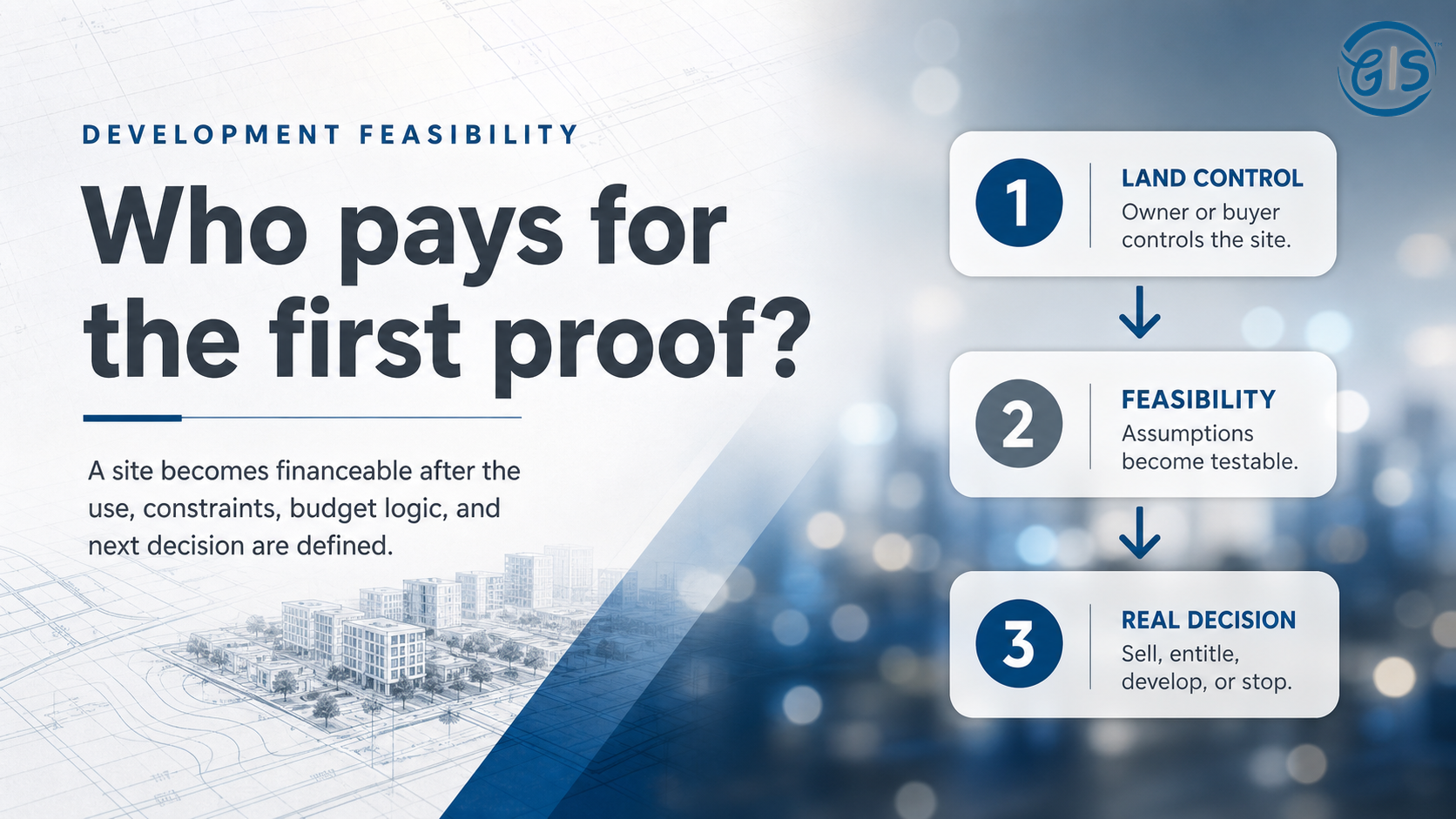
For a site to become legible to the market, someone has to pay for the first serious proof. In most cases, that first spend belongs to the person who controls the land or the buyer who has the site under contract.
What a Development Feasibility Study Is Supposed to Do
A development feasibility study sits before the finished design package, construction bid, appraisal, loan commitment, or investment memorandum. At the early stage, it is a structured test of whether the property appears capable of supporting a realistic development path.
The study should translate the parcel into practical questions: what could be built, what would need to be confirmed, where the early constraints are, what the entitlement path may look like, what cost categories could control the outcome, and whether the next spend is justified. It should also identify where the analysis is still preliminary. Early feasibility is useful because it separates known facts from assumptions that need to be tested.
For landowners, the result should be a clearer decision. The owner can compare selling as-is, adding entitlement clarity before selling, pursuing development management, or stopping before the next phase becomes more expensive.
Why Outside Parties Usually Do Not Pay for the First Proof
Owners sometimes expect a developer, investor, lender, contractor, or buyer to spend the first meaningful money proving the opportunity. That expectation is understandable, but it usually does not match how development risk is allocated.
A lender cannot underwrite a parcel in the abstract. A lender needs a credible program, budget logic, sponsor or guarantor capacity, entitlement path, collateral story, and exit strategy. Without those pieces, the conversation is preliminary.
An investor does not fund land potential by itself. Investors evaluate defined opportunities: use, timing, basis, risk, return, capital stack, control, and execution. If the site has not been translated into a credible plan, an investor has little to evaluate.
A contractor can provide early guidance, but accurate pricing depends on scope. Without a program, drawings, site assumptions, phasing, utilities, and procurement strategy, construction cost is still a range of judgment calls.
A buyer will price uncertainty into the offer. If the buyer has to absorb entitlement risk, utility risk, access risk, title risk, cost risk, and timing risk, the price will usually reflect that burden.
This is why the first feasibility spend is tied to control. The party that controls the land controls whether the opportunity becomes defined enough for others to engage seriously.
The Owner’s Real Question Is Usually About Risk
When an owner resists paying for feasibility, the objection is rarely about the line item alone. The owner is usually asking a deeper question: what if I spend the money and learn that the property does not work?
That is a legitimate concern. Development is not a linear process, and early analysis can produce an answer the owner does not want. The site may support fewer units than expected. Utility upgrades may change the economics. Access may limit the plan. Slope, drainage, easements, parking, fire access, or entitlement timing may reduce the apparent upside.
Avoiding the feasibility fee does not create free certainty. It usually means making a larger decision with less information. An owner can skip the early analysis and still lose value through a weak sale process, unrealistic pricing expectations, poor partner selection, premature design work, or a deal structure that gives away too much upside because the risk was never defined.
The purpose of feasibility is to reduce the size of the unknowns before the owner commits to more expensive work.
What the First Feasibility Pass Should Answer
The first feasibility pass should be proportionate to the decision. A small middle-housing site does not need the same level of analysis as a complex multifamily or institutional-scale project. The scope should match the property, timeline, and consequence of the decision.
At a minimum, a useful first pass should address the following:
- Property control: whether the person requesting the work owns the site, is under contract, or is evaluating a purchase.
- Intended outcome: whether the owner is considering a sale, entitlement strategy, development management, joint venture, or internal hold decision.
- Development paths: the realistic uses or product types that appear plausible based on the site and market.
- Entitlement direction: the likely process, obvious approvals, timing concerns, and jurisdictional questions requiring confirmation.
- Physical constraints: access, utilities, slope, drainage, site shape, buildable area, parking, fire access, and other conditions that could change the plan.
- Title and legal constraints: easements, covenants, encroachments, deed restrictions, or ownership issues that may affect execution.
- Cost drivers: the categories most likely to move the budget, even before detailed design or contractor pricing exists.
- Next-step roadmap: what should be confirmed next, what can wait, and what should not be funded unless the site passes the first screen.
The value of this work comes from sequencing. Good feasibility does not pretend the project is fully known. It identifies the few variables that control the next decision.
A Feasibility Study Can Support More Than One Outcome
Some owners assume feasibility is only useful if they decide to develop the property. That is too narrow.
A feasibility study can support a sale by helping the owner understand what a buyer is likely to discount. It can support an entitlement strategy by identifying what needs to be clarified before approaching the city or county. It can support a development management path by defining the early scope, team needs, and capital-readiness issues. It can also support a no-go decision when the site does not justify more spending.
That last outcome is often overlooked. A no-go decision may not feel satisfying, but it can save the owner from paying for design, consultants, legal structuring, capital-raising materials, or partnership negotiations around a project that was weak from the beginning.
The purpose is to make the owner less dependent on guesses before the expensive decisions begin.
How GIS Approaches the Role
GIS works as a development management and execution firm. The company works with landowners, family offices, and select investors, and helps owners evaluate development without automatically selling the land to a traditional developer.
GIS is not trying to buy or option land through the feasibility process. GIS also does not provide loans or funding as a standalone service. The first job is to help determine whether the site supports a realistic development path under real-world constraints.
If GIS is engaged as development manager and the project is credible, financing and capital work can become part of the broader assignment. That sequence is important. Capital is much more productive after the site, scope, entitlement path, budget logic, and execution plan are defined.
When to Use the Free Checklist
Owners who are still early should not necessarily start with a paid study. The free Development Feasibility Checklist is intended for that stage.
The checklist helps organize the basic facts that make a first development conversation useful: address or parcel number, ownership or contract status, timeline, target outcome, product type being considered, and known constraints such as access, utilities, slope, wetlands, easements, or title issues.
The checklist will not answer the development question by itself. It will help determine whether the site is ready for a serious feasibility conversation.
When to Schedule a Development Strategy Call
A strategy call makes sense when the property is specific and the decision is real. That usually means the owner controls the site, is under contract, has a deadline, is comparing a sale against development upside, or needs to decide whether the next spend is justified.
The call should clarify whether a paid feasibility study is the right next step. If the site is too early, the checklist may be enough for now. If the site is specific and the decision has financial consequences, feasibility is the path from raw possibility to a defined development question.